
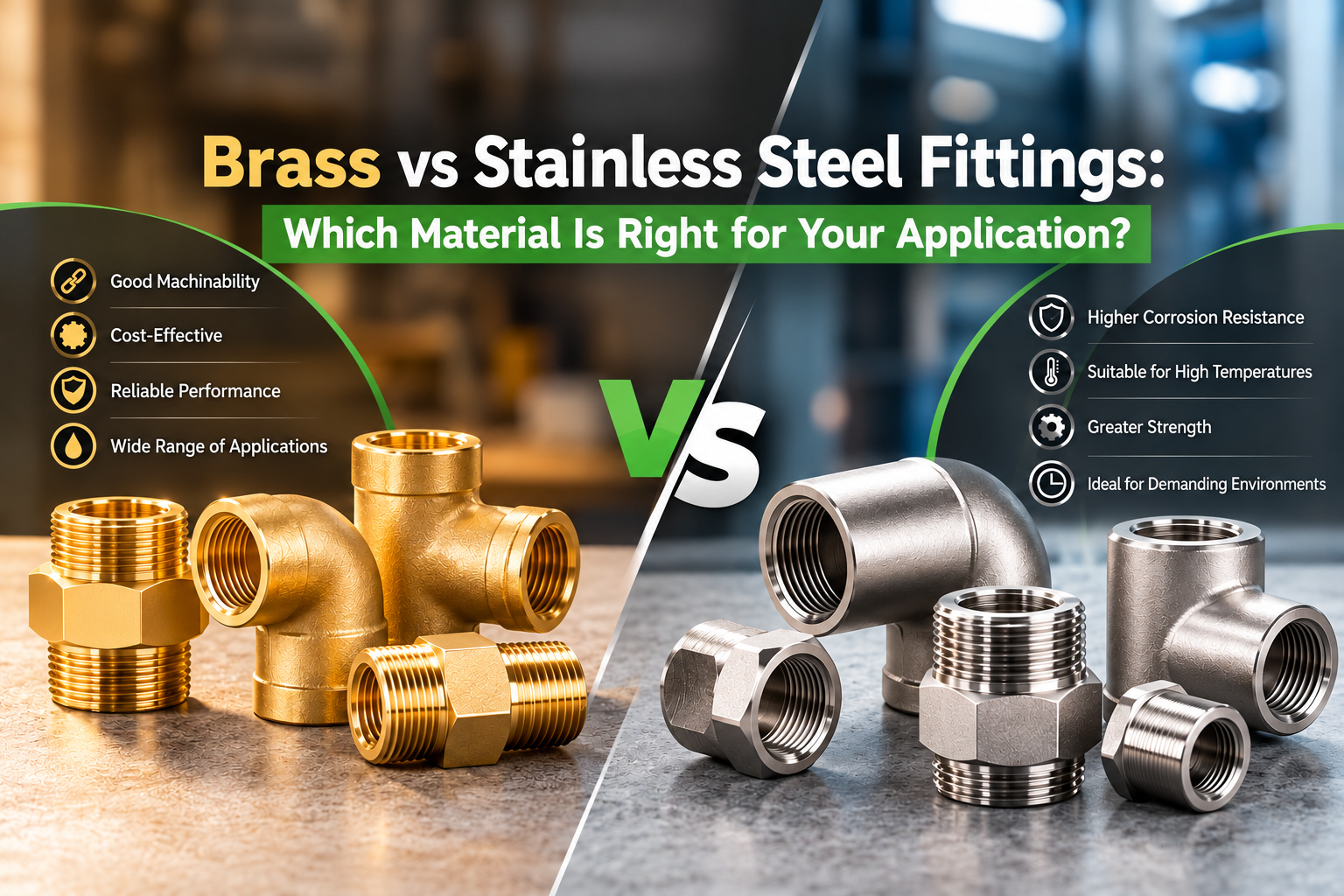
Choosing the right material for pipe fittings can have a significant impact on the reliability, lifespan, maintenance requirements, and overall cost of an installation. Brass and stainless steel are two widely used materials for fittings, but they have different properties that make each one suitable for particular applications.
So, when should you choose brass, and when does stainless steel make more sense?
The answer depends on factors such as the type of fluid or gas being handled, operating pressure and temperature, corrosion exposure, installation conditions, budget, and the required service life.
In this guide, we compare brass and stainless steel fittings to help you understand their differences and select the appropriate option for your application.
What Are Brass Pipe Fittings?
Brass fittings are manufactured from a copper-zinc alloy and are commonly used in plumbing, water supply, gas systems, industrial equipment, compressed-air systems, and many other applications.
One of the main advantages of brass is its combination of strength, machinability, corrosion resistance, and relatively easy installation. Brass can also be manufactured into a wide range of fitting configurations, including elbows, tees, adapters, connectors, couplings, and threaded fittings.
For applications where accurate threads and consistent dimensions are important, brass is particularly practical because the material can be machined efficiently while maintaining good dimensional accuracy.
What Are Stainless Steel Fittings?
Stainless steel fittings are made from steel alloys containing chromium, which helps create a protective oxide layer on the surface. Depending on the grade, stainless steel may also contain elements such as nickel and molybdenum to improve corrosion resistance and mechanical performance.
Stainless steel fittings are commonly used in demanding environments where exposure to moisture, chemicals, high temperatures, or corrosive substances can be a concern.
Common grades include 304 and 316 stainless steel, although the appropriate grade depends on the application and environmental conditions.
Brass vs Stainless Steel: Key Differences
1. Corrosion Resistance
Both brass and stainless steel can provide good corrosion resistance, but their performance depends heavily on the environment.
Brass generally performs well in normal plumbing, water, air, and many industrial applications. However, certain water chemistries and aggressive environments can cause problems such as dezincification in susceptible brass alloys.
Stainless steel, particularly suitable grades such as 316, can offer higher resistance in many harsh environments, including applications involving moisture and certain chemicals.
The important point is that “stainless steel” is not a single material. The grade needs to be selected according to the actual operating environment.
2. Strength and Pressure Requirements
Stainless steel generally provides higher mechanical strength than many common brass alloys. This can make it appropriate for applications involving higher mechanical loads, elevated pressures, or demanding operating conditions.
However, brass fittings can also provide excellent performance when correctly designed and manufactured for the intended pressure and temperature range.
Rather than choosing a material based only on its nominal strength, engineers should consider the complete fitting specification, including wall thickness, connection type, pressure rating, temperature, and applicable standards.
3. Machinability
Brass has an important advantage when it comes to machining.
Its machinability makes it suitable for producing precision threads, small components, complex geometries, and custom fittings efficiently. This is one reason brass is widely used for precision-engineered components.
Stainless steel can also be machined accurately, but it is generally more demanding to machine. Tool wear, machining speed, heat generation, and production time can all affect manufacturing costs.
For high-volume precision components, material machinability can therefore be an important consideration.
4. Cost
In many applications, brass can provide a practical balance between performance and cost.
The final cost of a fitting is not determined by raw material price alone. Manufacturing complexity, machining time, finishing, testing, tolerances, quantity, and required specifications all influence the total cost.
Stainless steel may involve a higher material and manufacturing cost, but that additional investment can be justified where its specific corrosion resistance or mechanical properties are required.
A cheaper fitting is not necessarily the better choice if it requires frequent replacement or cannot withstand the operating environment.
5. Temperature Performance
The operating temperature should always be considered before selecting a fitting material.
Stainless steel is widely used in applications involving elevated temperatures because suitable grades can maintain useful mechanical properties across demanding temperature ranges.
Brass also performs effectively across many common plumbing and industrial temperature ranges, but its suitability depends on the particular alloy, fitting design, pressure, and operating conditions.
Always check the manufacturer’s specifications rather than assuming that every brass or stainless steel fitting has the same temperature capability.
6. Electrical and Thermal Properties
Brass has good electrical and thermal conductivity because of its copper content. This can be advantageous in certain electrical, heat-transfer, and equipment-related applications.
Stainless steel has considerably lower electrical and thermal conductivity than brass.
Therefore, if conductivity is an important part of the application, brass may offer a practical advantage.
When Should You Choose Brass Fittings?
Brass can be a strong choice when you need:
- Reliable fittings for water and general plumbing applications
- Good machinability and accurate threaded connections
- A practical balance between performance and cost
- Components that are relatively easy to install and work with
- Precision-machined or custom-designed fittings
- Applications involving compressed air or suitable gas services
- Components requiring a range of shapes, threads, and configurations
For many commercial and industrial installations, brass offers a useful combination of durability, manufacturability, and corrosion resistance.
When Should You Choose Stainless Steel Fittings?
Stainless steel may be more appropriate when the application involves:
- Aggressive or corrosive environments
- High mechanical loads
- Certain chemical-processing applications
- Marine or high-moisture environments
- Elevated operating temperatures
- Applications where a particular stainless steel grade is specified
- Situations where long-term corrosion performance is a major consideration
However, the correct stainless steel grade should always be selected based on the actual service conditions.
Brass or Stainless Steel: Which One Is Better?
There is no universal winner between brass and stainless steel. The right choice depends on the application.
For general plumbing, water systems, precision-machined components, and applications where machinability and cost are important, brass can be an excellent option.
For harsh environments, demanding industrial applications, and situations requiring higher corrosion resistance or mechanical strength, stainless steel may be more appropriate.
The best approach is to evaluate the complete operating conditions rather than selecting a material based solely on price or popularity.
Choosing a Reliable Brass Fittings Supplier in India
Material selection is only one part of getting reliable fittings. The quality of manufacturing, dimensional accuracy, raw material control, threading, finishing, inspection, and consistency between batches can also affect the performance of the final component.
When evaluating brass pipe fittings manufacturers in India, consider factors such as:
- Manufacturing capabilities
- Material and alloy options
- Dimensional tolerances
- Threading accuracy
- Surface finishing options
- Quality-control procedures
- Custom manufacturing capabilities
- Experience with your industry and application
- Ability to meet required specifications consistently
A dependable brass pipe fittings supplier in India should be able to understand your technical requirements and recommend a suitable product rather than simply supplying a standard fitting.
Final Thoughts
Brass and stainless steel both have important roles in modern piping and industrial systems. Brass offers excellent machinability, good corrosion resistance, conductivity, and a practical balance of performance and cost. Stainless steel, meanwhile, can provide higher strength and excellent corrosion resistance when the appropriate grade is selected.
Before making a decision, consider the fluid or gas being handled, pressure, temperature, environmental exposure, connection requirements, expected service life, and overall project budget.
For businesses sourcing precision-engineered brass components and fittings, working directly with an experienced manufacturer can also make it easier to select the appropriate material, dimensions, threads, and finish for the intended application.
Venus Enterprise manufactures brass components and fittings for a range of industrial requirements, with a focus on precision, consistency, and application-specific manufacturing.


