
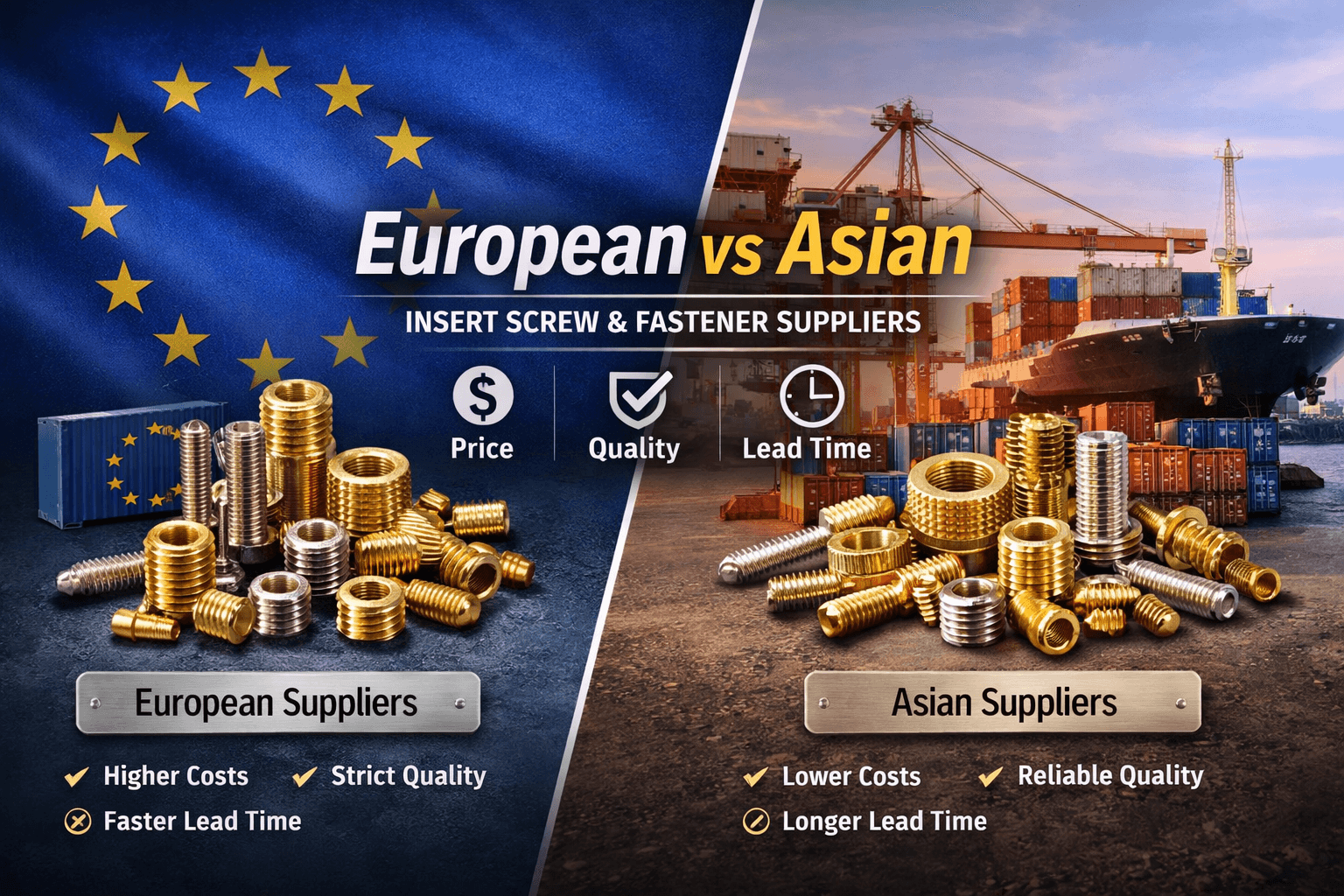
Global manufacturers and procurement managers are under constant pressure to reduce costs while maintaining product quality and reliable delivery schedules. One of the most strategic decisions businesses face today is choosing between European and Asian insert screw and fastener suppliers.
While European suppliers are traditionally associated with strict compliance and high-quality engineering, Asian manufacturers—particularly in countries like India—have become increasingly competitive in pricing, manufacturing capability, and export efficiency.
This guide provides a practical cost comparison between European and Asian fastener suppliers, focusing on three critical factors: price, quality, and lead time. Whether you’re sourcing brass inserts, threaded fasteners, or precision components, understanding these differences can help you make a more profitable and reliable procurement decision.
Pricing Breakdown: European vs Asian Fastener Suppliers
When evaluating suppliers, pricing is often the first factor procurement teams analyze. However, the total cost of sourcing insert screws and fasteners involves more than just the manufacturing price.
It typically includes:
- Raw material cost
- Labor and production cost
- Packaging and logistics
- Shipping and freight charges
- Import duties and tariffs
- Inventory holding costs
Understanding the complete cost structure is essential for accurate comparison.
1) Production Cost Comparison
European manufacturers generally operate in high-cost labor markets with strict regulatory requirements. These factors significantly increase production costs compared to Asian manufacturers.
In contrast, Asian suppliers benefit from:
- Lower labor costs
- High-volume manufacturing
- Established export infrastructure
- Competitive raw material sourcing
Typical Production Cost Difference
| Factor | European Supplier | Asian Supplier |
| Labor Cost | High | Moderate to Low |
| Manufacturing Cost | Higher | Lower |
| Tooling Cost | Moderate | Competitive |
| Economies of Scale | Limited | High |
| Overall Unit Cost | Expensive | Cost-efficient |
This is why many global buyers search for a European fastener supplier vs Asian manufacturer comparison before making procurement decisions.
2) Shipping and Logistics Cost
Shipping costs vary depending on distance, order volume, and shipping method. While European suppliers offer shorter shipping distances within the EU, Asian exporters often offset longer transit times with significantly lower production costs.
For bulk orders, ocean freight from Asia is typically more economical than sourcing from European manufacturers.
Shipping Cost Factors
- Freight method (air vs sea)
- Order quantity
- Packaging size and weight
- Port handling charges
- Customs clearance fees
In many cases, the total landed cost from Asia remains lower despite longer shipping routes.
3) Tariffs and Import Duties
Tariffs depend on the destination country and trade agreements. Some regions impose duties on fasteners imported from certain countries, which can influence supplier selection.
However, many Asian manufacturers structure exports to comply with international trade regulations, reducing the impact of tariffs on overall procurement costs.
Insert Screw Price Comparison: Europe vs Asia
The insert screw price comparison Europe vs Asia typically shows a noticeable difference in unit pricing, especially for high-volume orders.
Example Cost Comparison for Insert Screws
| Cost Element | Europe | Asia |
| Production Cost | Higher | Lower |
| Shipping Cost | Moderate | Moderate |
| Tariff Impact | Variable | Variable |
| Total Landed Cost | Higher | Lower |
For companies purchasing large quantities of brass inserts or threaded fasteners, even a small difference in unit price can significantly impact annual procurement budgets.
Quality & Compliance Differences Between European and Asian Suppliers
Quality assurance and compliance standards are critical considerations when selecting fastener suppliers. European manufacturers are known for strict regulatory compliance, but many Asian manufacturers now meet the same international standards.
Modern Asian manufacturers often operate under globally recognized certifications such as:
- ISO 9001: Quality Management
- ISO 14001: Environmental Management
- ISO 45001: Occupational Health & Safety
- IATF 16949: Automotive Quality Standards
These certifications ensure consistent production quality, traceability, and reliability.
Material and Manufacturing Standards
Both European and Asian suppliers produce fasteners according to international standards, including:
- DIN
- ISO
- BS
- ASTM
Quality is no longer determined by geography alone. Instead, it depends on:
- Manufacturing processes
- Quality control systems
- Testing and inspection procedures
- Engineering capability
Many buyers who previously relied on European suppliers are now sourcing from certified Asian manufacturers without compromising performance or durability.
Inspection and Testing Capabilities
Reliable suppliers implement strict inspection procedures to maintain consistent product quality.
Typical quality control processes include:
- Dimensional inspection
- Thread accuracy testing
- Material composition verification
- Surface finish evaluation
- Packaging inspection
These practices ensure that fasteners meet international performance and safety requirements.
Fastener Lead Time: EU vs Asian Suppliers
Lead time plays a crucial role in supply chain planning, especially for industries such as automotive, electrical, construction, and manufacturing.
The fastener lead time EU vs Asian suppliers comparison often depends on production capacity and logistics efficiency.
Typical Lead Time Comparison
| Process Stage | European Supplier | Asian Supplier |
| Production Time | Moderate | Fast |
| Order Processing | Fast | Fast |
| Shipping Time | Short | Longer |
| Overall Lead Time | Moderate | Competitive |
Although shipping from Asia may take longer, many manufacturers compensate by offering:
- High production capacity
- Faster manufacturing cycles
- Flexible order scheduling
As a result, total lead time can be similar or even shorter in some cases.
Inventory and Supply Chain Flexibility
Asian suppliers often provide flexible production scheduling and scalable manufacturing capacity. This allows buyers to:
- Place bulk orders
- Maintain safety stock
- Reduce procurement risk
- Improve supply chain reliability
These advantages are especially valuable for companies managing global distribution networks.
Case Studies: European Companies Switching to Asian Fastener Suppliers
Many European manufacturers have successfully transitioned to Asian suppliers to reduce costs while maintaining product quality and reliability.
Case Study 1: Automotive Component Manufacturer
A European automotive parts manufacturer was sourcing threaded inserts locally at a high production cost. Rising operational expenses reduced profitability.
After evaluating global sourcing options, the company switched to an Asian supplier.
Results
- Reduced procurement costs
- Maintained product quality
- Improved production efficiency
- Achieved consistent supply availability
This transition allowed the company to remain competitive in a price-sensitive market.
Case Study 2: Electrical Equipment Manufacturer
An electrical equipment manufacturer faced delays due to limited production capacity from its European supplier.
The company partnered with an Asian manufacturer offering higher production capability.
Results
- Shorter manufacturing cycles
- Reliable delivery schedules
- Improved inventory management
- Reduced operational disruptions
This change strengthened the company’s supply chain stability.
Why Many Global Buyers Choose Asian Fastener Suppliers?
Today, businesses are increasingly sourcing from Asia due to the combination of cost efficiency, manufacturing capability, and export reliability.
Key reasons include:
- Competitive pricing
- High production capacity
- International quality standards
- Flexible order quantities
- Reliable export logistics
- Strong technical expertise
Companies looking for a reliable global partner often evaluate suppliers based on long-term value rather than short-term cost savings.
Choosing the Right Fastener Supplier for Your Business
Selecting the right supplier requires balancing three critical factors:
- Price
- Quality
- Lead time
The best supplier is not necessarily the cheapest or the closest—but the one that consistently delivers reliable products and dependable service.
When evaluating suppliers, consider:
- Manufacturing capability
- Quality certifications
- Export experience
- Production capacity
- Communication reliability
- Delivery performance
A supplier with strong engineering expertise and proven export capabilities can significantly improve supply chain efficiency.
Conclusion
The decision between European and Asian insert screw and fastener suppliers ultimately depends on your business priorities. While European manufacturers offer proximity and regulatory familiarity, Asian suppliers provide competitive pricing, scalable production, and global export capability.
For companies seeking cost efficiency without compromising quality, sourcing from experienced manufacturers with international certifications and advanced manufacturing infrastructure can deliver long-term operational advantages.
With decades of expertise in precision manufacturing and global exports, Venus Enterprise supports customers worldwide by delivering high-quality brass inserts, fasteners, and custom components that meet international standards and industry requirements.


