
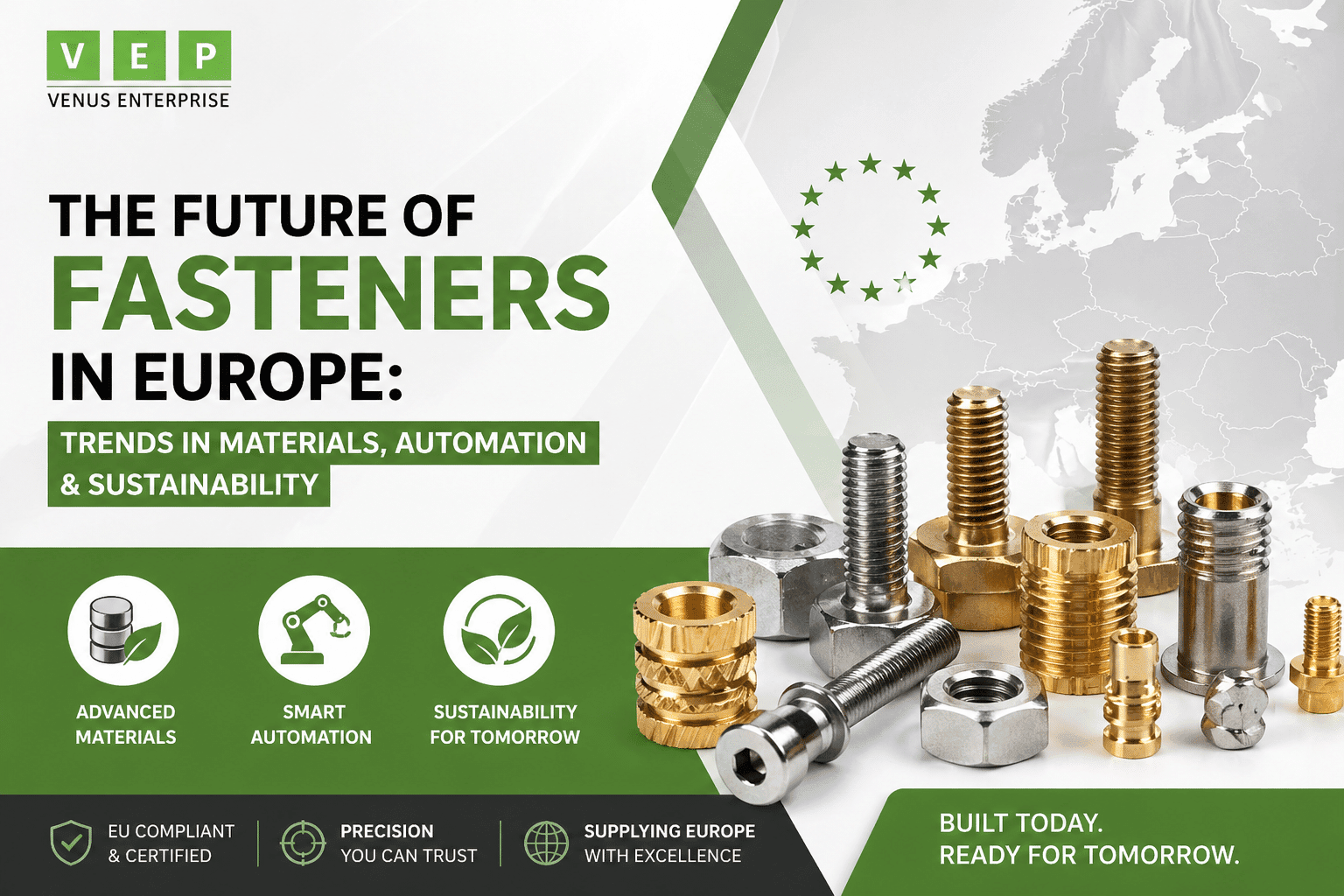
Europe’s fastener industry is at a turning point — and if you’re sourcing sustainable fasteners in Europe, what worked five years ago simply won’t cut it today. New EU mandates, smarter production lines, and a wave of eco-conscious engineering are rewriting the rules for every buyer, OEM, and procurement head on the continent.
At Venus Enterprise, we’ve been manufacturing and exporting precision brass fasteners and insert components for over two decades. Here’s what we’re seeing — and what it means for your supply chain.
The Rise of Eco-Friendly Materials in Fastening
The conversation around materials has shifted dramatically. Where hardness and tensile strength once dominated spec sheets, European engineers and procurement teams now ask a second question right alongside those: What happens to this part at end of life?
The push toward eco-friendly insert screws and biodegradable-compatible fastening solutions isn’t academic — it’s being driven by the EU’s Ecodesign for Sustainable Products Regulation (ESPR), which is rolling out requirements across sectors including electronics, construction, and automotive.
What does this look like in practice? A few real developments we’re tracking:
Bio-based and recyclable alloys are gaining traction in non-structural applications. Aluminium and certain brass alloys — including the lead-free variants our team has manufactured under RoHS-compliant standards — are well-positioned here. Brass is inherently recyclable without loss of property, which gives it a genuine sustainability advantage over coated steel fasteners that degrade during recovery.
Lead-free brass has become non-negotiable for European buyers. Our entire product range is manufactured using lead-free brass and certified to REACH compliance, which removes a major regulatory friction point for customers importing into Germany, the Netherlands, and Scandinavia — markets where environmental procurement standards are especially strict.
Reduced-waste manufacturing is equally important. European buyers increasingly request documentation on machining waste ratios and recycling rates at source. Our facility in Jamnagar uses precision CNC turning that minimises swarf and recovers material back into the production cycle.
Smart Manufacturing & Automated Fastening — What’s Actually Changing
Walk through an automotive assembly plant in Stuttgart or a white goods facility in Łódź today and you’ll notice something: fewer people placing fasteners by hand, and more robotic torque systems doing it with repeatability that human lines can’t match.
Automated fastening is no longer a premium-tier feature — it’s a baseline expectation in high-volume European manufacturing. What this means for fastener suppliers is significant: components must meet extremely tight dimensional tolerances because automated feeders and torque tools have zero tolerance for variance.
This is an area where our automated sorting and inspection systems matter directly to our customers. Every batch we ship goes through automated dimensional sorting — not just sampling — so that the 50,000 inserts going into an automated assembly line in Bavaria behave identically from the first piece to the last.
Beyond tolerances, smart manufacturing is driving demand for traceable fasteners — components that can be documented through the supply chain with lot codes, material certificates, and test data. We issue full material traceability documentation as standard, which supports our European customers’ internal quality management systems, particularly those operating under IATF 16949 — the same certification our facility holds.
Case Study: Electronics Manufacturer in Munich, Germany
A contract electronics manufacturer in the Munich industrial corridor was facing a compliance issue: their existing insert screw supplier couldn’t provide REACH and RoHS documentation in the format required by their Tier 1 automotive customer. Assembly line downtime due to documentation gaps was costing them more per week than a year’s worth of fastener spend.
Our team stepped in with a rapid sample-to-approval process. We supplied M3 and M4 brass inserts with full material certification, REACH declaration of conformity, and dimensional inspection reports within the first shipment. Their procurement lead later told us the turnaround from inquiry to approved supplier status took under three weeks — a timeline that surprised them, given the cross-continental supply chain.
Case Study: Furniture OEM Supplier, Veneto Region, Italy
A mid-sized OEM furniture hardware supplier operating across the Veneto region — serving high-end cabinetry brands across northern Italy and exporting to France — had a seasonal challenge. Their Q3 order volumes (driven by European furniture trade show cycles and autumn retail stocking) would spike sharply, putting pressure on their existing fastener inventory.
They needed a supplier who could handle bulk procurement flexibility without minimum order rigidity that would leave them sitting on excess stock in Q1. We worked with their team to structure pre-season orders with staggered dispatch schedules, using our brass fasteners and washer range. The result: they reduced their fastener-related inventory holding costs by managing dispatch timing rather than stockpiling, and had documented traceability for their sustainability reporting to retail buyers.
How Manufacturers Are Adapting to EU Sustainability Mandates
The EU’s sustainability agenda is accelerating. Between the ESPR, the Corporate Sustainability Reporting Directive (CSRD), and the Battery Regulation (which has knock-on implications for EV assembly fastener sourcing), European procurement teams are dealing with a compliance landscape that changes faster than many supplier relationships do.
Here’s how the manufacturers we work with are adapting — and what we’ve put in place to support them:
Material documentation at source. European buyers need their supply chain documentation to be audit-ready. Our quality team issues RoHS, REACH, and material composition certificates as standard — not on request.
Eliminating restricted substances early. Rather than waiting for regulatory deadlines, forward-looking procurement teams are already transitioning away from cadmium-plated and lead-containing fasteners. Our brass screws and insert components have been lead-free by default for years.
Supplier consolidation for traceability. Many European OEMs are reducing the number of fastener suppliers they work with specifically to improve supply chain traceability. A single accountable manufacturer — one who can provide full lot documentation — is easier to audit than five regional distributors. We support this model with detailed quality records and responsive account management.
Our Products at a Glance
| Product | Description |
|---|---|
| Brass Inserts | Heat, ultrasonic, and moulded inserts for plastic assemblies; precision-machined to tight tolerances |
| Brass Fasteners | Full range of brass bolts, screws, and studs; lead-free, REACH compliant |
| Screws | Machine screws, self-tapping screws, and specialty screws in brass and other materials |
| Nuts & Bolts | Hex nuts, coupling nuts, and bolts across metric and imperial specifications |
| Washers | Flat, spring, and lock washers; supplied to precise surface finish requirements |
| Brass Pipe Fittings | Compression and push-fit fittings for fluid and gas applications |
| Brass Cable Glands | IP-rated glands for industrial electrical enclosures and panel wiring |
| Brass Turned Components | Custom CNC-turned brass parts to drawing; OEM and custom specifications |
| Brass Forged Parts | High-strength forged brass components for valves, fittings, and structural use |
| CNG/LPG Brass Parts | Precision parts for alternative fuel systems; pressure-rated and tested |
Why European Buyers Work With Us
We’re an IATF 16949 certified manufacturer — the automotive quality management standard — which means our production systems, documentation, and process controls meet the requirements of one of the most demanding industries in the world. For non-automotive buyers, it simply means your parts come from a facility where quality isn’t left to chance.
Our certification portfolio includes:
- IATF 16949 — Automotive quality management system
- RoHS compliance — Restriction of hazardous substances
- REACH compliance — Registration, Evaluation, Authorisation and Restriction of Chemicals
- Lead-free manufacturing — Standard across our entire product range
We work on bulk order basis with competitive ex-works pricing, and our team responds to enquiries within 24 hours. We don’t do vague quotes — if you send us a drawing or specification, you’ll receive a real number.
For a deeper look at how we approach quality at every stage, visit our Quality page and About Us.
Frequently Asked Questions
Get in Touch
If you’re evaluating fastener industry trends in Europe and thinking about where your supply chain needs to be in two years — not just today — we’d be glad to have that conversation.
📍 India Manufacturing Facility: Revenue Survey No. 478/1, Jamnagar-Rajkot Highway, Khijadiya, Jamnagar – 361120, Gujarat, India 📞 +91 90994 08448 📧 info@vebrass.com
📍 USA Office: 42616 Greystone Drive, Sterling Heights, MI 48313 📞 734-756-7771 | 734-925-4264 📧 psw@vebrass.com
🕐 We reply within 24 hours.


